Elizabeth Hervey, Countess of Bristol

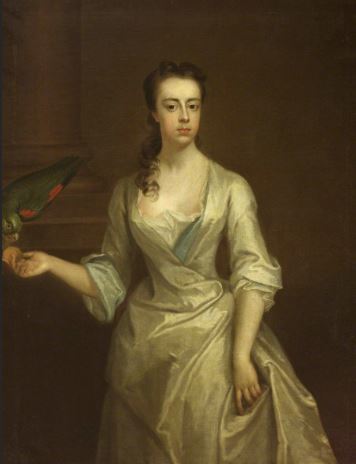
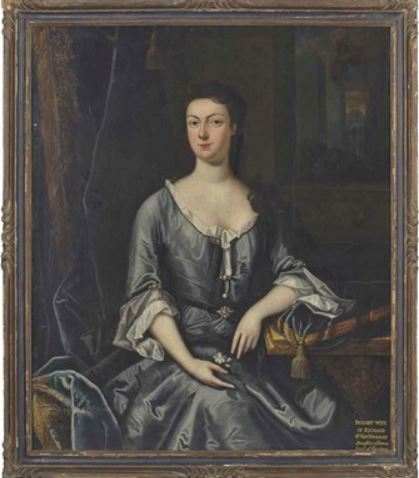
Elizabeth Felton was born on December 18, 1676 the only daughter of Betty and Sir Thomas Felton. One cannot help but wonder what Elizabeth Felton’s childhood was like. She was probably well provided for – never short of a new gown or two – but with a mother like Betty Felton, lewd and pocky, according to a popular 17th century verse – well, what an example to set a young girl.

Lady Elizabeth Hervey, Countess of Bristol

Lady Elizabeth Hervey, Countess of Bristol


The eighteen year old heiress married John Hervey, 1st Earl of Bristol, at Boxted Church, Suffolk on July 25, 1695, becoming his second wife. Whig MP for Bury St Edmunds from 1694 – 1703, John Hervey was a lover of bloodstock breeding and horse matches and his Suffolk home was suitably close to that hub of horse racing, Newmarket. Yet, despite their incompatibility - she like town, he liked country – theirs was a devoted marriage.

John Hervey, 1st Earl of Bristol

John Hervey, 1st Earl of Bristol

When he was away from home they sent each other love letters by each post. He addresses Elizabeth as ‘My ever new Delight’ while she calls him ‘My dear dear life.’ In a letter dated December 30, 1696 she adds a PS ‘The children are all well. I beg your pardon for forgetting them last time; but you’ll forgive it when I tell you the thoughts of you would leave no room for anything else.’

Lady Elizabeth Hervey, Countess of Bristol

Lady Elizabeth Hervey, Countess of Bristol

The children were John’s family by his first wife Isabella, a son Carr and two daughters Catherine and Isabella. Elizabeth’s first child, John was born in the first year of her marriage and like most high born 18th century women, Elizabeth was pretty much permanently pregnant for the next 18 years  She would have a further 16 children plus a set of triplets born in 1701 that did not survive and a still born son in 1704. In 1699 she had two babies within 12 months – Thomas was born on January 20 and William on December 25. James Porter Hervey died in 1706 barely two months old. Humphrey Hervey born in 1708 died young and Felton born in 1710 died at 13 days old while James was just 14 months old when he died in 1714.

(c) National Trust, Ickworth; Supplied by The Public Catalogue Foundation

Lady Elizabeth Hervey, Countess of Bristol with her twins, Charles and Henrietta

Her six daughters fared slightly better, although Henrietta died aged nine years old and her same named sister at sixteen. Barbara was 27 when she died and eldest daughter Elizabeth made it to 29. Louisa, wife of Sir Robert Smyth, was 55 when she died and Anne made it to her 64th birthday.

Lady Barbara Hervey, named after her maternal grandmother

Lady Barbara Hervey, named after her maternal grandmother

In 1718 aged 42, her child bearing years over, Elizabeth was one of six Ladies of the Bedchamber appointed to Princess Caroline of Ansbach who later became the Queen Consort of George II. Elizabeth continued in this role until the Queen’s death in 1737.

Elizabeth’s six page will, written in December 1740, contains considerable detail concerning her home in Bury St Edmunds. She leaves the house and all the plate, goods, pictures, china and furniture for the use of her husband and following his death, to their youngest son Felton.

At the time she wrote her will, Elizabeth had outlived ten of her children. Her eldest son was to act as trustee for her property and she leaves him  ’my cabinet chest large screen and small screen being white Japan of my own work in confidence that he will preserve them for my sake.’

To her unmarried daughter Lady Ann she leaves ‘my gilt Etoilet and all the furniture and things thereunto belong and also ‘that Snuff Box with her father’s picture in it.’

Lady Ann Hervey as a child

Lady Ann Hervey as a child

To her other surviving daughter Lady Louisa Caroline Isabella Smyth she leaves ‘my Ring with my Lord’s picture and another Ring set with the late Queen’s hair as also the said Queen’s picture now in my house at Bury.’

She leaves a large emerald ring to her husband which she asks that he wear ‘for my sake’ and the rest of her jewellery and Rings she leaves ‘unto my Trustees and Executors to sell and dispose of.’

She leaves instructions that her granddaughter Elizabeth Hervey, eldest daughter of her son Henry, should be placed under the care and supervision of Sir John and she bequeaths her £1,000 when she attains the age of 21 years, or when she gets married.

One last bequest, Elizabeth wants her maiden name of Felton to be added to the names of her sons and grandsons in remembrance of her family.

Elizabeth died on May 1, 1841 being seized with a fit as she was in St James’ Park in her sedan chair. She was buried in the Hervey family vault at St Mary’s Church, Ickworth, Suffolk.

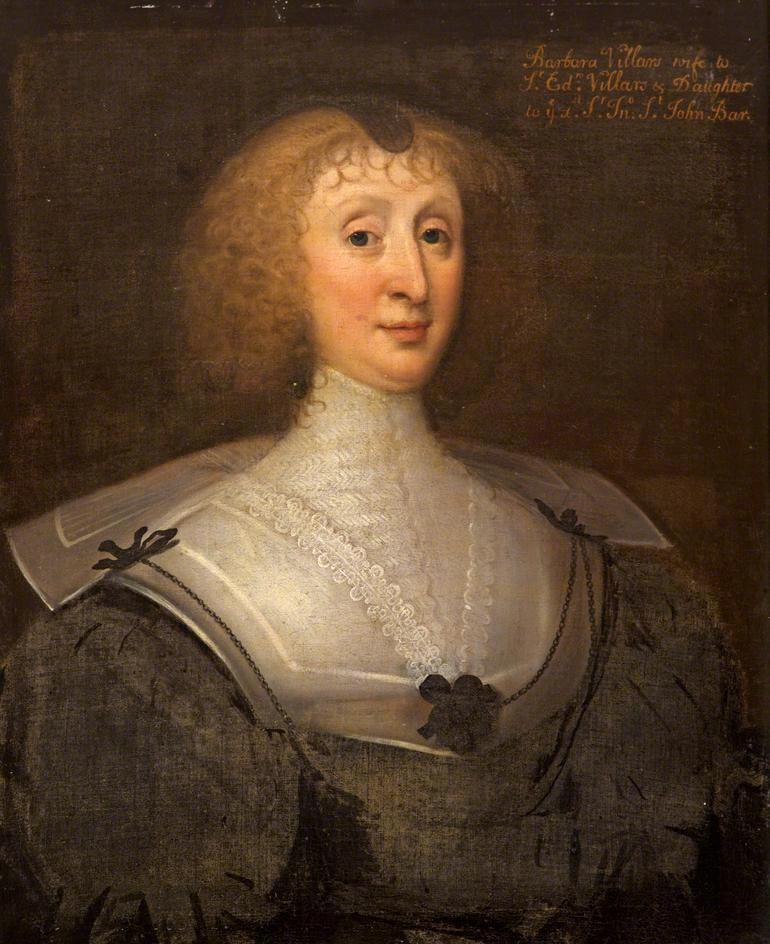
Barbara St John, wife of Sir Edward Villiers

Barbara St John, wife of Sir Edward Villiers

And for those readers wondering how Elizabeth Hervey, Countess of Bristol is connected to the St John family at Lydiard House – her maternal grandmother was Barbara Villiers, the daughter of Sir Edward Villiers and Barbara St John.

Lady Mary Villiers

Sometimes it seems as if the 17th century St John family is related to just about everyone of any note …or otherwise, actually!

For example, Lady Mary Villiers’s father was murdered by a relative of the husband of her first cousin once removed. Now how’s that for a coincidence.

NPG 711; The Duke of Buckingham and his Family after Gerrit van Honthorst

The Duke of Buckingham and his Family

Lady Mary Villiers was the eldest child and only daughter of George Villiers, 1st Duke of Buckingham and his wife Catherine Manners. George was one of those characters one either loved or loathed. James VI Scotland and I England obviously loved him – a lot. In her latest BBC 2 series Fit to Rule: How Royal Illness Changed History, Dr Lucy Worlsey looks at letters from the King to his favourite and reveals the complex relationship between the two men. Good looking, charming George played the role of lover, father, son, best friend, slave and dog, but perhaps we won’t delve into the ‘dog’ role too deeply.

George Villiers, 1st Duke of Buckingham

George Villiers, 1st Duke of Buckingham

After the King’s death in 1625 Charles I kept George close to him, as friend and advisor, much to the exasperation of Charles’s ministers and his Queen. George definitely got in the way of not only the king’s parliamentary progress but procreation with his Queen as well.

When Lieutenant John Felton polished him off there were a lot of people who were none too sorry. Especially Queen Henrietta Maria who produced a son Charles James nine months later. But Charles did mourn his friend and took George’s three young children into his protection, raising them alongside his own family.

Lady Mary Villiers

Lady Mary Villiers

Consequently young Lady Mary became a desirable proposition in the marriage stakes. And in January 1634/5 she was wed to Charles, Lord Herbert of Shurland, the son of another of James’s favourites. Lady Mary was twelve years old and her groom fifteen. She appears with her husband to be and his family in a painting by Anthony van Dyck. However, the marriage was a brief one as young Charles contracted smallpox while on military service in Italy and died a year after the wedding.

Lady Mary Villiers 2

Lady Mary – posing as St Agnes

On August 3, 1637 Lady Mary married for a second time. Her new husband was a royal cousin, James Stuart 4th Duke of Lennox, and a marriage much favoured by Charles I who gave the bride away at the ceremony held in the Archbishop’s Chapel at Lambeth Palace.

Lady Mary’s second marriage lasted 18 years and produced two children, a son Esme born in 1649 and a daughter Mary born in 1651.

John_Michael_Wright_Mary_Villiers_and_her_children

Lady Mary and her two children

James Stuart, Duke of Lennox and Duke of Richmond, died in 1655, impoverished by his long and faithful service to Charles I, £65,000 poorer and ostracized by the reigning Parliamentarians.

In 1668 Lady Mary married for the last time. Her third husband was Colonel the Hon Thomas Howard, Lieutenant of the Yeoman of the Guard, whom she outlived by seven years.

Mary_Villiers,_Duchess_of_Richmond_and_Lennox_(1622_–_85)_-_Google_Art_Project

Lady Mary Villiers, Duchess of Richmond and Lennox

So was Lady Mary ever anything more than a very marriageable proposition?

Now we already know that the Villiers clan were pretty broadminded, and with a father like George it seems inevitable that Mary and her brothers would be pretty uninhibited.

Described as a ‘bisexual adventuress’ Lady Mary has been identified as Ephelia, an anonymous 17th century poet, whose work contained lesbian and bisexual references. And they say she liked to share a tipple with that legendary St John drinker John Wilmot, 2nd Earl of Rochester. And she may have had a fling with the king’s handsome nephew Prince Rupert – oh, and she liked to wear men’s clothing and she enjoyed various ‘manly’ sports such as shooting and fencing. So she was quite a gal!

Lady Mary died in November 1685 and was buried in Westminster Abbey close to her father George and her aunt Barbara.

So how was she and her father’s murderer related to the St John family? Right – are you sure you’re ready for this?

Copyright Lydiard House / Supplied by The Public Catalogue Foundation

Barbara St John – wife of Sir Edward Villiers

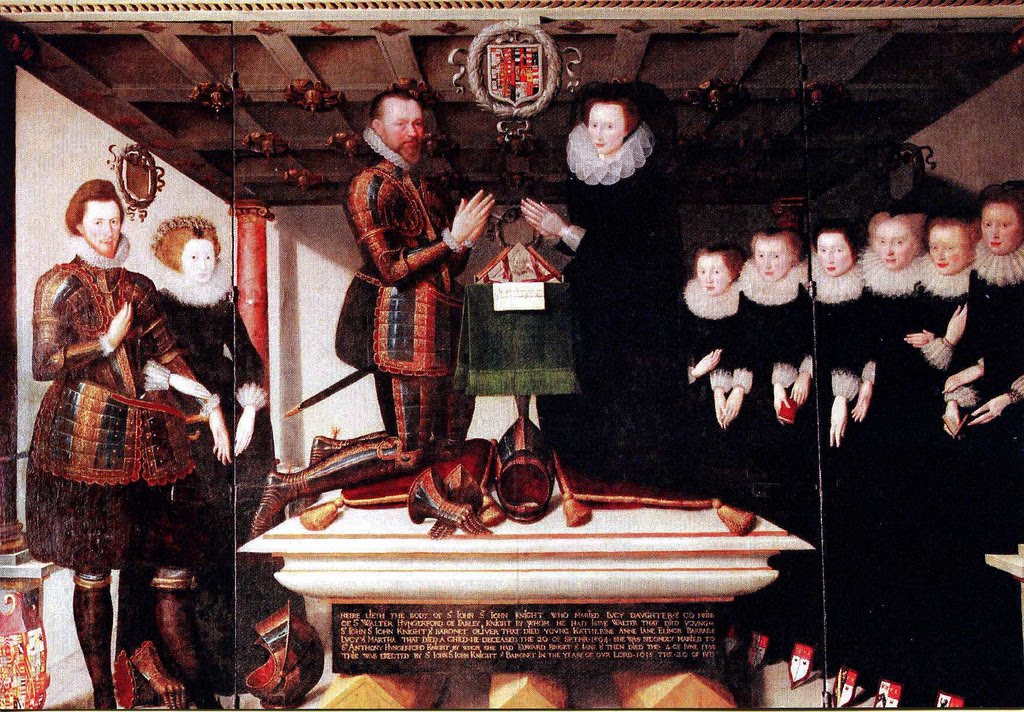
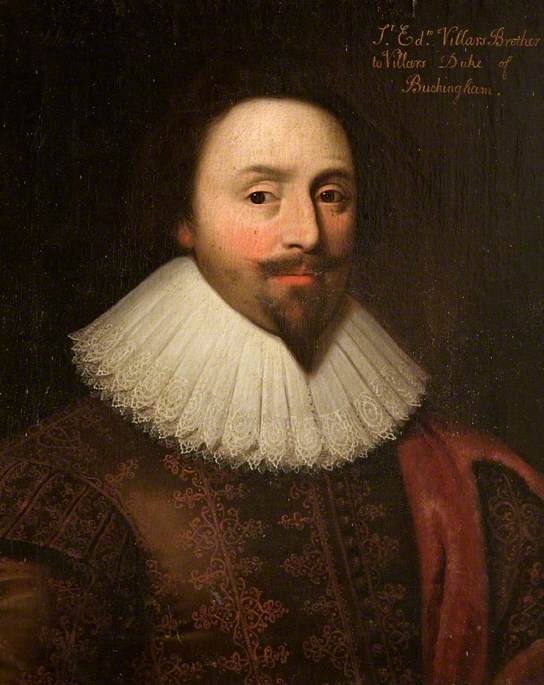
Lady Mary’s father George Villiers, 1st Duke of Buckingham, had an elder half brother Sir Edward Villiers. Sir Edward married Barbara St John, the daughter of Sir John St John and Lucy Hungerford, who appear on the St John polypytch in St Mary’s Chruch Lydiard Tregoze. Their granddaughter Elizabeth Howard married Sir Thomas Felton, 4th Baronet of Playford Hall, Suffolk.

Now George was murdered by Lieutenant John Felton. Felton had taken part in Buckingham’s unsuccessful expeditions in Cadiz 1625 and the Isle of Rhe 1627. Overlooked for promotion and out of pocket, Felton harboured a grudge against Buckingham and decided it was his duty to rid the country of this menace. He bought a dagger for tenpence and walked to Portsmouth where Buckingham was preparing for an expedition to Rochelle. He gained entrance to Buckingham’s house and on August 23, 1628 stabbed him over the heart, killing him pretty much instantly. Felton was later hanged at Tyburn. John Felton was a member of the junior branch of the Playford Hall Feltons.

Ta – da *takes a step forward with arms outstretched.* Now please don’t ask me to go through all that again.

Joan Beaufort, Countess of Westmorland

When the remains of Richard III were found beneath Greyfriars Car Park, Leicester in September 2012 many had great and perhaps unrealistic expectations.  Some hoped his skeleton would show a straight spine, quashing the Shakespearean caricature.  But sadly Richard did indeed suffer from scoliosis. And his remains were unable to redeem his character either, no matter how much Philippa Langley of the Richard III Society wished that they could, and there is little doubt that he was responsible for the murder of his young nephews – the Princes in the Tower.

A reconstruction of his skull and facial features reveal a remarkable similarity to the 15th/16th century portrait that hangs in the National Portrait Gallery.

And me, well I hit the genealogy trail in the anticipation that he would be connected to the extended St John family and I for one wasn’t disappointed.

Richard III’s niece Elizabeth of York married the man who defeated and succeeded him, Henry VII.  Henry Tudor was the grandson of Margaret Beauchamp whose first husband was Sir Oliver St John.  But I knew this already – I was sure there must be another link, and of course there was.

Joan Beaufort was born in about 1397. The date and place of her birth remain up for debate, probably because she was one of several illegitimate children born to John of Gaunt, 1st Duke of Lancaster, and his mistress Katherine Swynford.

John of Gaunt

Katherine had been employed as governess to John’s daughters Phillippa and Elizabeth – well you know how these things happen?

It is believed that Joan was probably born at Kettlethorpe Hall, Lincolnshire, a property owned by her mother’s first husband Sir Hugh Swynford. But then she might also have been born at Beaufort Castle on her father’s French estate.

When she was about ten years old Joan and her three brothers were declared legitimate by their cousin Richard II. John of Gaunt made sure there was no misunderstanding and got the seal of Parliamentary approval in 1397as well. And then just to make jolly well sure, he married their mother in Lincoln Cathedral on January 13, 1396 with papal approval.

It is likely Joan spent her childhood in France where in 1391 she was married off to Baron Sir Robert Ferrers.  Joan was widowed with two daughters before she reached the age of 16.  On February 3rd 1397 she married Ralph de Neville, 1st Earl of Westmorland, who had also been married once before.

Joan had fourteen children by this second marriage. Four sons died young but the rest of the children made advantageous marriages. Daughter Lady Cecily Neville married Richard 3rd Duke of York and was the mother of two kings, Edward IV and the recently discovered Richard III.

Edward IV

The Beaufort descendants played a major role in the War of the Roses, a period of tumultuous upheaval in Britain.  With more contenders for the throne than you could shake a stick at, the warring cousins juggled the crown jewels between them during a thirty year period.

But this is only one thread in the St John genealogical tapestry.  Joan’s brother was John Beaufort, 1st Earl of Somerset and it was his son, John 1st Duke of Somerset, who married the widowed Margaret Beauchamp, Lady St. John.  Their daughter was the saintly Margaret Beaufort, who like her great aunt Joan was married off young. The son she bore when little more than a child herself, went on to become Henry VII, the first of the Tudor monarchs and married his third cousin, Joan Beaufort’s great granddaughter.

Elizabeth of York, Joan Beaufort’s great granddaughter, married Henry VII

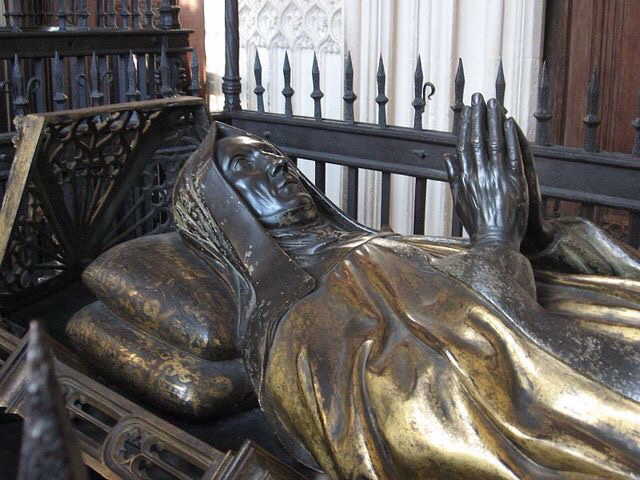
Joan died on November 13, 1440 at her Yorkshire home in Howden.  She was entombed next to her mother in the Katherine Swynford chantry close to the High Altar in Lincoln Cathedral.

The tombs of Katherine Swynford and Joan Beaufort courtesy of jenthelibrarian

Oh and by the way, more than 350 years later, on May 23, 1804 Lady Joan’s descendant, Lady Sarah Sophia Fane, daughter of the 10th Earl Westmorland married the 5th Earl of Jersey, George Child Villiers, another St John descendant – more follows about this Good Gentlewoman.

File:Sarah Sophia Child Villiers, Countess of Jersey (née Fane) (1785-1867), by Alfred Edward Chalon.jpg

Lady Sarah Sophia Fane, Countess of Jersey

The Three Wives of General Frederick St John

It has to be said that the St John men didn’t make very good husbands, but that didn’t stop them from trying! Frederick St John enjoyed a distinguished military career and lived to the age of 79. He married three times, yet very little is known about any of his wives.

Frederick St John 2nd Viscount Bolingbroke

Frederick St John 2nd Viscount Bolingbroke

Frederick was the second son of that ill fated match between Frederick, 2nd Viscount Bolingbroke and Lady Diana Spencer.  His parents’ marriage ended in scandal and divorce, but that was nothing compared to the antics of his elder brother.  George Richard St John deserted his first wife, had an incestuous affair and four sons with his half sister and duped his second wife into thinking their marriage was legal.

Lady Diana Bolingbroke

Lady Diana Bolingbroke

Like so many second sons Frederick’s destiny was the army.  He entered as an ensign in the 85th Foot in 1779 aged just 14 years old and quickly climbed the military career ladder becoming lieutenant, captain and then major in the 104th Ft.  Frederick served as a subaltern in the West Indies until 1781 and then as a captain in Jersey and Guernsey, until  1783.

Frederick married the first of his three wives at his mother’s Twickenham home by special licence on December 9, 1788.  Lady Mary Kerr was the third daughter of William John Kerr, 5th Marquess of Lothian and his wife Elizabeth Fortescue.  Although little is known of Lady Mary, a friend of letter writer and artist Mary Granville, Mrs Delany, it can be assumed that she was no dullard.

Mary Granville, Mrs Delany

Mary Granville, Mrs Delany

This first marriage was a short one as Mary died giving birth to a son Robert William on February 5, 1791.  Her body was brought to the St John family home at Lydiard Park and she was buried in the family vault at St Mary’s Church.

Described by the Prince of Wales as ‘one of the most amiable young men I know,’ the compliment raises more questions about Frederick’s character than it answers. Others described him as vain and after a spot of political meddling, Frederick continued with his much more successful military career.

On April 6, 1793 he married 18 year old Arabella Craven, third daughter of William Craven 6th Earl Craven of Hampstead Marshall.  Arabella could trace her maternal ancestry back to Charles Lennox, Duke of Richmond, the illegitimate son of Charles II and his mistress Louise Kerouaille, Duchess of Portsmouth.  Arabella’s mother, Elizabeth Berkeley seems to have inherited a generous dollop of Old Rowley’s roving genes.  Elizabeth left Arabella’s father to travel the continent, eventually settling down with the Margrave of Anspach whom she married after the death of her husband. A writer of satirical plays, she penned numerous comedies including Somnabule; a musical farce called Silver Tankard and Miniature Picture.

Elizabeth Berkeley - mother of Arabella Craven

Elizabeth Berkeley – mother of Arabella Craven

Frederick and Arabella had three sons, George William born 1796; George Frederick Berkley 1797 and Henry John in 1798. The following year Frederick returned to India where he was to serve for another six years. No further children were born between 1798 and 1805 suggesting that Arabella did not accompany her husband. In 1807 a daughter Maria Arabella was baptised at the parish church in Ogbourne St Andrew, a village two miles north of Marlborough on the road to Swindon. A further five babies were baptised at this church suggesting the couple lived close by, just a few miles from the mansion house at Lydiard Tregoze.

Arabella died at her Grosvenor Place, her London home, on June 9, 1819 aged 45 and like Frederick’s first wife, was buried in the family vault at St Mary’s, Lydiard Tregoze.

St Mary's Church, Lydiard Tregoze.

St Mary’s Church, Lydiard Tregoze.

Frederick tried his luck in the political stakes and was returned MP for Oxford in 1818.  It was but a brief adventure, and he was defeated at the poll in 1820, after which he decided not to re-enter Parliament.

But he wasn’t past giving marriage another go, this time to Caroline Parsons, more than 25 years his junior.  The couple were married on November 14, 1821 at Godstone, Surrey and made their home in Brighthelmstone, Sussex where their two sons Henry Edward and Welbore William Oliver, were born.

Frederick died on November 19, 1844, the second senior general in the army.  His third wife survived him by more than 25 years.

Frederick’s service is detailed in the East India Military Calender recording that  ...’he was in command for 4 years of the principal depot, Caunpoor; and where he formed the army for the field, by the most constant and unwearied instruction; and when that army was reviewed by the Marquess Wellesley, he received the most marked public thanks in general orders, for having rendered it efficient, both in movement and discipline, beyond his lordship’s utmost hopes.  He likewise served as second in command under Lord Lake, throughout the Mahratta campaigns, and commanded the left wing of the army.  At the battle of Delhi, his services were of the highest important.  At a critical moment, he charged, with his wing of sepoys, the whole of the enemy’s artillery, consisting of 100 pieces, (chiefly 18 pounder cannonades) and at the moment enfilading the British advance.  Lord Lake, in his despatch to the Governor General, observes, “Major Gen. St John was opposed to the enemy’s right; the steadiness and ability displayed by the Honourable the Major General, quickly surmounted every difficulty, and forced the enemy to retire with very heavy loss.”

He was also present at the siege of Agra, where he was chosen to drive in a sortie made by the enemy.  The Com. In Chief, in his despatch on this occasion, thus notices his services – “My thanks are due to the Hon. Major Gen St John, for his spirited conduct in advancing at the head of the 2d batt. 2d N.I. which I found it necessary to order up to support the attack.”

Sadly his three wives form just a footnote in the St John family history.  If Lady Mary Kerr had survived childbirth, would we have learned more about her life?  If Arabella Craven had    followed the most popular female family occupation, would we know more about her personality?  Despite more than twenty years of marriage we know next to nothing about Caroline Parsons.  And of the three women, I have only been able to discover one portrait, that of Arabella as a child with her nurse.

Arabella as a child pictured with her nurse

Arabella as a child pictured with her nurse

Henrietta, Lady Luxborough

The St John ladies of Lydiard Park certainly had a penchant for gardening.  From Johanna, famous for her herbal remedies, to Diana, artist wife of Frederick ‘Bully’ Bolingbroke, who sought solace in the walled garden, the Lydiard ladies left their mark on the estate. And for Johanna’s granddaughter Henrietta, her love of gardening would sustain her through exile and isolation.

In ‘My Darling Heriott’ her biographer Jane Brown describes Henrietta as a ‘hands on and muddily booted’ gardener from early childhood.

Henrietta as a child

Henrietta as a child

The only surviving daughter of Henry, 1st Viscount St John and his French, second wife Angelica Pelissary, Henrietta spent her childhood summers in the old fashioned formal gardens at Lydiard Park.  It was her brother John who remodelled the mansion house and swept away his grandmother’s gardens as he had the grounds landscaped in the style of  Lancelot ‘Capability’ Brown.

Henrietta was born on July 15, 1699 in the midst of the squabbling St John family.  Her father Henry had proved a huge disappointment to his Puritan parents Sir Walter and Lady Johanna St John.  A dissolute libertine, Henry had murdered Sir William Estcourt in a pub brawl and it was only the intercession of his cousin Barbara, Countess of Castlemaine, Charles II’s mistress, that saved his neck.

Henrietta’s half brother, the mercurial statesman Henry St John, 1st Viscount Bolingbroke and Queen Anne’s Secretary at War, despised his father and rebelled against the grandparents into whose protection he had been placed when Henry senior had been forced to flee the country.

In the middle of this quarrelsome household Henrietta and her much elder half brother Henry formed the closest of bonds.  In fact there was a scurrilous rumour that little Henrietta might actually be ‘brother’ Henry’s own daughter by his stepmother Angelica.

Henrietta St John

Henrietta St John

Henrietta, with her mass of unfashionable black hair and tall frame, was beautiful in an unconventional way.  She was intelligent, amusing and gregarious with a romantic inclination, qualities that, unfairly but ultimately proved her downfall.

It was brother Henry who introduced her to banker Robert Knight, the son of the Chief Cashier of the South Sea Company who was instrumental in the bubble bursting scandal.

This portrait is thought to commemorate the marriage of Henrietta and Robert Knight

This portrait is thought to commemorate the marriage of Henrietta and Robert Knight

Following a short engagement the couple were married at St George’s, Hanover Square on June 10, 1727.  Robert and Henrietta set up home in Paris with Henrietta’s in laws where they lived for a little over a year.  Their son Harry was born at Henry Bolingbroke’s Dawley home.  A daughter Madelaine Henrietta was born in 1729 at the family’s London home.  When the baby was just five months old the Knight in laws demanded that Henrietta return to Paris to act as a hostess for their establishment.  When not required to be in attendance upon her in laws, Henrietta would return to England, staying with her childhood friend Frances, Lady Hertford.

It was on one such visit to the Hertford’s home in Marlborough during the winter of 1735/36 that Henrietta met the handsome young poet John Dalton, tutor to the Hertford’s son Viscount Beauchamp.

There was never any hard proof as to the nature of Henrietta’s relationship with Dalton, ten years her junior.  Incriminating poems and a letter Henrietta claimed to be a copy or translation of another were all that emerged as she insisted theirs had been but a light hearted, platonic flirtation. But Knight was having none of it.

Gossip abounded. Henrietta supposedly gave birth to a third child late in 1736, the product of this affair, about whom there is scant evidence. And the Earl of Egremont recorded in his diary dated August 11, 1736 “that Mr Knight had separated from his wife (daur of my Lord St John) finding her a bed with Dr Peters, her physician, but allows her 500l a year out of respect to her family.”

Robert Knight, hardly Mr Squeaky Clean himself, was indignant, as was Henrietta’s pot calling half brother Henry.

Robert issued his wife with two alternatives.  She could either live in his house, confined to one floor, deprived of the means to keep in touch with friends and banned from seeing her children. Or she could retire to the Knight family home at Barrell’s Hall in Warwickshire on an income of £500.

Barrell's Hall

Barrell’s Hall

Henrietta tried living in her husband’s London home before opting for the Barrell alternative.  Despite the restrictions on her movements – she was forbidden to go within 20 miles of London – and the dilapidated state of Barrell’s Hall – Henrietta made the best of a bad lot, even adopting the title Lady Luxborough when her estranged husband was raised to the peerage.

She surrounded herself with literary companions, developing her garden at Barrell’s in consultation with the poet William Shenstone.

She soon got to work on the neglected 56 acre estate, writing to her friend Lady Hertford in 1742 ...”I have made a garden which I am filling with all the flowering shrubs I can get.  I have also made an aviary, and filled it with a variety of singing birds, and am now making a fountain in the middle of it, and a grotto to sit and hear them sing, contiguous to it.  This, as it is seen from every window of the house, affords me some amusement. And in a coppice a little farther I have made a very lovely cave shaded by trees.”

Henrietta planted snowdrops, primroses, polyanthus and violets, which she described as ‘the beauties of childhood’ - perhaps a reference to Lydiard where the snowdrops flourish today.

Carpet of snowdrops outside the walled garden

Carpet of snowdrops outside the walled garden

During 1749/50 she planted a lane of white poplars, a lime avenue and built a ha-ha and a summer house.

Until the end of her life Henrietta worked hard in her garden writing in November 1749 that she had “stood from Eleven to Five each day, in the lower part of my Long Walk, planting and displanting, opening views, etc.”

She left the house and gardens in a far better condition than she had found them.  Towards the end of her life people of so called taste visited Barrell’s and upon her death her estranged husband couldn’t wait to get his hands on it.

Henrietta died on March 26, 1756 aged 56. She had been reunited with her daughter but never enjoyed a close relationship with her son.  She is buried at St Peter’s Church, Wootton Wawen, Warwickshire.

2012 in review

I’d like to say a huge thank you to my readers for their support during Good Gentlewoman’s first year.  Actually, this blog isn’t officially a year old yet, just nine months in fact, but has already passed the 20,000 page view mark.

In 2012 there were 63 new posts – and 354 pictures uploaded, that’s about seven per week. The busiest day of the year was August 20, when the conundrum of Lady Dorothy Carey’s portrait received top viewing.

Lady Dorothy Carey

Lady Dorothy Carey

Top Good Gentlewoman of all time is Elizabeth Bourchier, the long suffering wife of Lord Protector Oliver Cromwell, who during her lifetime received an inordinate amount of bad press.  But not so on the pages of GG where she has received more than 1,500 page views.

Elizabeth Bourchier, Mrs Oliver Cromwell

Elizabeth Bourchier, Mrs Oliver Cromwell

In second place is poor Frances Winchcombe, the first wife of attainted politician Henry St John, 1st Viscount Bolingbroke.  Read about her lonely life and Henry’s cruel comments when she died in 1718.

Frances Winchcombe

Frances Winchcombe

Also up there in the top ten posts is greedy Barbara Villiers, Countess of Castlemaine, mistress of Charles II about whom Barbara’s cousin John Wilmot, Lord Rochester wrote – ‘God bless our good and gracious king, whose promise non relies on; who never said a foolish thing, nor ever did a wise one.’

Barbara Villiers - Countess of Castlemaine

Barbara Villiers – Countess of Castlemaine

Do I have a favourite Good Gentlewoman? Well resourceful Mary Anne Ruthven has to be one of them – the wife of Bow Street detective and government spy, George Ruthven, she is my great-great-great grandmother.

2013 is all set to be a pretty spectacular year and I have some fascinating ladies waiting in the wings for you to meet. Thank you for your support and I look forward to meeting new readers.

Lady Margaret Beaufort – The King’s Mother

banner_lady_margaret_beaufort

In her novel The Red Queen Philippa Gregory tells the story of a girl sacrificed by her single minded mother to the machinations of a warring royal family.  Married at 12 to a man twice her age, she endures permanent damage to her body during childbirth just a year later.

Heiress to the red rose of Lancaster, Margaret Beaufort is a strikingly pious child, the blurb on the book tells us. Saints’ knees her stigmata, she has a fierce and unwavering sense of destiny.  If not a nun, then she’ll be Queen of England and sign her name Margaret Regina: Margaret R.

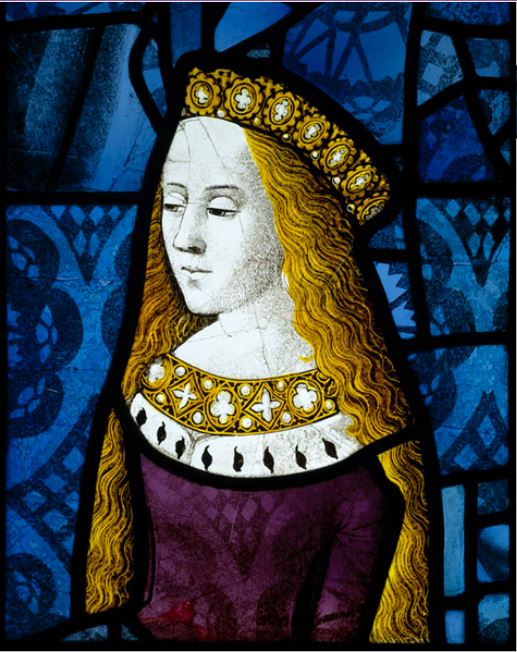
Believed to be Lady Margaret Beaufort by an unknown artist

Believed to be Lady Margaret Beaufort by an unknown artist

So how does historical fiction stand up to the facts?

Margaret Beaufort was born on May 31, 1443, the daughter of Margaret Beauchamp and her second husband John Beaufort, 1st Duke of Somerset. John Beaufort was at the centre of a complicated royal family.

His father, another John Beaufort, was the illegitimate son of John of Gaunt and his mistress Katherine Swynford whom he later married.  The children were legitimised, which resulted in an awful lot of contenders for the throne.

John of Gaunt was a younger son of Edward III.  His eldest brother and heir to the throne Edward ‘The Black Prince’ predeceased the king their father and was in turn succeeded by his son Richard II. However Richard II  was deposed in 1399 by John of Gaunt’s son Henry IV.

Lady Margaret was most probably born at the Beaufort home of Kingston Lacy near Wimborne Minster although she spent her childhood at her mother’s Bletso home with her St John half siblings. Her father died soon after her birth, some sources say by his own hand, and her cousin Henry VI granted her wardship to William de la Pole, Earl of Suffolk and steward of the royal household. Aged just six she was married to the Earl’s seven year old son, although allowed to remain with her mother on the Betso estate.

Following the death of Henry V in 1422 the tussle for the throne began. Add to this the rise of the Welsh Tudors when Henry V’s widow Catherine married Owen ap Meredith Tudor, and threw two more sons, Edmund and Jasper, into the monarchical mix.

Lady Margaret Beauchamp published courtesy of Duncan and Mandy Ball

Lady Margaret Beauchamp published courtesy of Duncan and Mandy Ball

In 1453 Margaret and her mother were summoned to the Court in London where Henry VI revoked the de Pole’s wardship, turning it over to his own half brothers Jasper and Edmund Tudor.  With the young girl’s marriage to John de Pole dissolved the scene was set for her to take centre stage.

From 1455 to 1485 the Houses of Lancaster and York slugged it out in the War of the Roses and as the civil war ebbed and flowed it is easy to see how important young Margaret was to prove.

Her reappearance on the marriage market in 1455 saw her quickly snapped up by none other than her guardian, Edmund Tudor, who at 24 was twice her age.

Margaret Beauchamp obviously played a key role in brokering her Beaumont daughter’s second marriage and Ms Gregory paints the picture of a hard, unfeeling mother.

When the 13 year old Margaret suffers agonising child birth she hears her governess speak to the midwives.

‘Your orders are to save the baby if you have to choose. Especially if it is a boy.’ ‘That’s the right thing to do,’ Nan agrees. ‘But seems hard on the little maid’ …’It is her mother’s order,’ my lady governess says, and at once I don’t want to shout at them any more.’

An astute business woman who drove a hard bargain and provided well for her St John off spring, it remains unknown whether Margaret Beauchamp was in fact this cold and callous.

Lady Margaret Beaufort

Lady Margaret Beaufort

Edmund Tudor died of plague and didn’t live to see his son Henry Tudor born.  The teenage widow and her baby son lived with her Tudor relatives in Wales, but the child was soon made the ward of William, Lord Herbert with whom he lived until he was twelve years old.  When Edward IV regained the throne in 1471 Henry fled to Brittany where he spent the next 14 years. For more than twenty years Margaret spent little time with the son she adored and whose right to the throne she campaigned for so fervently.

Margaret would marry twice more, not easy for a deeply pious woman, physically damaged by childbirth.  Her second husband was Sir Henry Stafford, her third marriage to Thomas, Lord Stanley took place in 1472.


Henry VII

Henry VII

Henry Tudor returned to England in August 1485 where he defeated Richard III at the Battle of Bosworth Field and was proclaimed King of England by right of conquest.  His marriage to Elizabeth of York eldest daughter of Edward IV united the two royal households and secured the Tudor throne for more than one hundred years.

As the King’s Mother, Margaret enjoyed status, influence and independence.  Eminent Tudor historian Dr David Starkey describes her as the most powerful woman in England of her day.

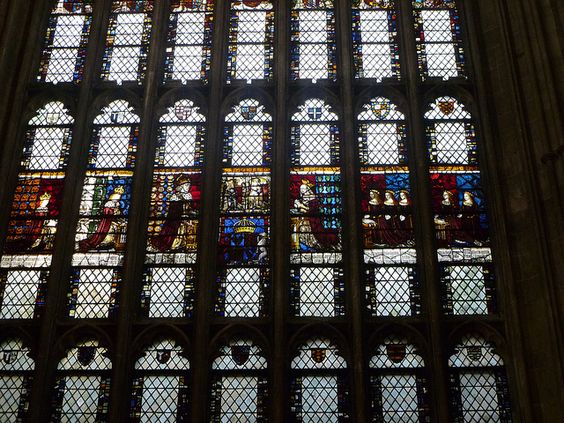
Lady Margaret Beaufort depicted in a stained glass window in St Botolph's Church, Boston.

Lady Margaret Beaufort depicted in a stained glass window in St Botolph’s Church, Boston.

A sponsor of printer William Caxton, she translated and published the Imitation of Christ by Thomas a Kempis along with other devotional works. Founder of Christs’s and St John’s Colleges at Cambridge she endowed the Lady Margaret professorships of Divinity at both Oxford and Cambridge University.  In 1499 Margaret took a vow of chastity before Archbishop Fisher and lived out the last years of her life as she had always wanted, devoted to pray and study.

Margaret died aged 66 on June 29, 1509, just two months after her son.  She is buried in the Henry VII Lady Chapel in Westminster Abbey.

Lady Margaret's tomb in Westminster Abbey

Lady Margaret’s tomb in Westminster Abbey

Philippa Gregory ends her novel with Henry’s victory at Bosworth Field.

They bring the news to me where I am praying, on my knees, in my chapel.  I hear the bang of the door and the footsteps on the stone floor, but I don’t turn my head.  I open my eyes and keep them fixed on the statue of the crucified Christ and I wonder if I am about to enter my own agony. ‘What is the news?’ I ask.

Christ looks down at me, I look up at Him. ‘Give me good news,’ I say as much to Him as to the lady who stands behind me.

‘Your son has won a great battle,’ my lady in waiting says tremulously. ‘He is King of England, acclaimed on the battlefield.’

I gasp for breath. ‘And Richard the usurper?’

‘Dead.’

I meet the eyes of Christ the Lord and I all but wink at Him.  ’Thanks be to God,’ I say, as if to nod at a fellow plotter. He has done His part.  Now I will do mine.  I rise to my feet and she holds out a letter to me, a scrap of paper, from Jasper.

‘Our boy has won his throne, we can enter our kingdom. We will come to you at once.’

I read it again.  I have the strange sensation that I have won my heart’s desire and that from this date everything will be different.  Everything will be commanded by me.

The Red Queen by Philippa Gregory